Friday, March 1, 2013

China executes 4 foreigners over Mekong murders


BEIJING (AP) -- China executed four foreigners on Friday for killing 13 Chinese sailors in an attack on the Mekong River, following a live nationwide broadcast showing them being led to their deaths that harkened back to the mass public execution rallies of past years.

The attack on the sailors on the Mekong highlighted drug smuggling and extortion rackets along the vital waterway and led to a major expansion of Chinese police powers in the region.

Accused ringleader Naw Kham and accomplices Hsang Kham, Yi Lai, and Zha Xiha were found guilty of the killings. The four are of Myanmar, Thai, Laotian, and unknown nationality.

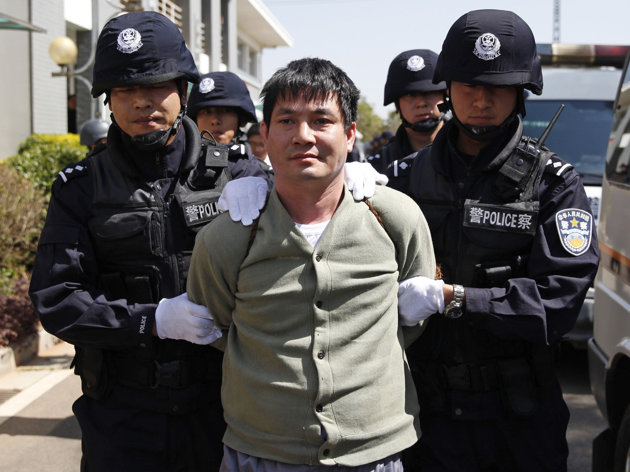
In the unusual live broadcast, state-run CCTV showed the four being led in shackles and handcuffs from their cells at a jail in southwestern Yunnan province's capital of Kunming prior to their execution by lethal injection. Their deaths were announced two hours later by the Yunnan provincial police department.

China has mostly abandoned the once-common practice of parading condemned criminals before crowds in stadiums and through city streets on the way to execution grounds on the edge of cities.

The broadcast was a response to widespread Chinese outrage over the killings, as well as an attempt to emphasize the heinousness of the crime and the efficiency of China's police and courts in doling out justice, said Prof. Yu Guoming of Renmin University's School of Mass Media.

"The brutality of Naw Kham in the killing really got ordinary Chinese people riled up. It's no wonder that it has attracted such huge attention from the public," Yu said.

The gang was accused of ambushing two flat-bottomed Chinese cargo ships on the upper reaches of the Mekong River on Oct. 5, 2011, in Myanmar waters infested with gangs that make their living from protection rackets and the production and smuggling of heroin, methamphetamine and other drugs. The Mekong flows south from Yunnan through the infamous Golden Triangle region, where the borders of Myanmar, Laos and Thailand meet, and provides a vital trade and transportation route between southwestern China and Southeast Asia.

The ships were recovered downriver later that day by Thai police following a gun battle with gang members, and the bodies of the 13 victims, some bound by the hands before being stabbed and shot, were fished from the river over the following days. Methamphetamine was found on the boats, leading to speculation they had been hijacked as part of a drug smuggling plot.

However, gang members later testified the killings were in retaliation for the ships refusing to pay protection money and allowing themselves to be used by Thai and Laotian soldiers in attacks on warlord bases. They said the drugs were placed on board to make it look like there had been a struggle between smugglers.

China's Public Security Ministry made the case a top priority, forming a 200-officer special investigation group and working with Thai, Lao, and Myanmar authorities to gather evidence and track down the perpetrators. Naw Kham was arrested in Laos last April and turned over to China the following month along with the other defendants. Because the killings took place on board Chinese-flagged vessels, Beijing, whose massive economy and powerful military give it considerable sway over its smaller southern neighbors, ruled the trials should take place in China.

The four were sentenced to death in November in a two-day trial, and the judgment was upheld by China's Supreme People's Court in Beijing following an automatic appeal in accordance with Chinese law.

In their testimony, the four said they had conspired with renegade Thai soldiers, nine of whom were arrested in October 2011 in Thailand and charged with taking part in the killings. They have yet to be tried or extradited, and remain in Thai army custody.

Months after the killings, China established a multinational river patrol headquartered in Yunnan which Beijing says has been effective in clamping down on such incidents.

"The case set a precedent that China would vigorously pursue criminals who commit crimes against its nationals. That's led to an expansion of Chinese police powers into the neighboring region and a big boost in Chinese influence," said Jin Canrong, associate dean of Renmin University's School of International Studies in Beijing.

China has devoted increasing attention to the safety of its nationals abroad as the Chinese economy continues to expand overseas. In recent years, Beijing has used navy ships and air force planes to help evacuate Chinese workers from fighting in Libya, and its diplomats have worked to free kidnapped workers and resolve local disputes across Africa and parts of Asia.

___

Associated Press researcher Yu Bing in Beijing and writer Thanyarat Doksone in Bangkok contributed to this report

Tuesday, February 26, 2013

UNILAG students damage Davido’s car after concert


Dami Duro crooner, Davido, this evening, got more than he bargained for at the University of Lagos, after excited fans chased him in his car and ended up breaking one of the windows.

The HKN artiste, was in the institution to perform at the First Bank-sponsored Youth Excel Programme. After he held his audience captive with a great performance, the students refused to let him leave, trailing him to his car.

Davido, who just released controversy ridden single, ‘Gobe’, however took it in good faith.

He tweeted: “Damn they broke my car window at Unilag!! Still luv ma fans tho!! Bless yall!! Amazing show!”

Culled from Daily Post

Monday, February 25, 2013

“Django Unchained” star Jamie Foxx was upstaged on the red carpet by his stunning 19-year-old Daughter Corinne


“Django Unchained” star Jamie Foxx was upstaged on the red carpet by his stunning 19-year-old daughter Corinne, who was dressed in a strapless midnight blue gown with woven bodice.

The actor, who brought along the beauty – then just 11! – to the Oscars in 2005 when he won for “Ray,” gushed on the red carpet that he was “excited to show how beautiful my daughter has turned out.” Last September, Foxx told omg! that he takes the “homey” approach to raising both of his daughters (he’s also dad to much-younger Annalise). "Like with my oldest daughter, I say, 'Hey, if you're going to drink, pour your own drink, no drugs,’” joked Foxx. “You learn that it's all still the same parenting process, regardless if you're a celebrity or if you're just a person who's working nine to five.

The main thing is staying really, really close to them and making them understand that you've been through things and you can help them, but don't try to live your life for them."

Court Denies Babalakin’s Plea To Sit Outside Dock


A Lagos High Court presided over by Justice Adeniyi Onigbanjo today denied the chairman of Bi-Courtney, Mr. Wale Babalakin his plea to sit outside the dock during the resumption of his trial over money laundering.

Justice Onigbanjo also ordered Mr. Babalakin to consolidate into one, two applications filed seeking to quash the charges against him.

Mr. Babalakin and 4 others are facing a 27-count charge of allegedly laundering about N4.7 billion on behalf of the convicted former governor of Delta State, James Ibori under the guise of purchasing a Challenger Jet Aircraft.

The judge’s ruling followed arguments from Mr. Lateef Fagbemi, the lead counsel to Mr. Babalakin, and Mr. Rotimi Jacobs, the counsel to the EFCC.

When the proceedings commenced, Mr. Fagbemi (SAN) made a peculiar request asking presiding Justice Onigbanjo to allow his client leave the dock and sit in or near the bar.

The counsel quoted Section 210 of the Administration of Criminal Justice Law of Lagos, 2011. The section provides that “where a defendant appears before the court on a summons, he may be required to enter the dock, stand or sit adjacent to it as may be ordered by the court”.

But the counsel to the EFCC, Senior Advocate of Nigeria, Mr. Jacobs, opposed the request. For him, the section did not refer to sitting in the outer or inner bar with the other lawyers. The prosecution stressed that justice must be seen to be done to all and not to the status of one.

Justice Onigbanjo, however, held that the section of the law refers to a defendant who appears before the court on a summons and not one like Mr. Babalakin who appeared before the court on information.

The defendant was, therefore, ordered to remain in the dock.

On the arguments on the applications filed by Mr. Babalakin to quash the charges against him, Justice Onigbanjo noted that there were two of such applications seeking the same objective.

While the defence counsel, Mr. Fagbemi insisted that they had different grounds, the prosecution countered by saying that it was an abuse of court process and a move aimed at delaying the trial. He, therefore, urged the court to strike out one of the applications.

The arguments went back and forth for almost 30 minutes on the propriety of taking the two applications seeking the same relief.

After listening to the arguments and the submissions of other lawyers in the matter, Justice Onigbanjo ordered the defendants to consolidate their applications.

He then adjourned the case till the 27th of March.

Nigeria grants bail to Russian arms smuggling suspects


Fifteen Russian sailors charged with illegally bringing weapons into Nigeria last year were granted bail on Monday and released until a hearing in early April, a Lagos court ruled.

Nigerian authorities intercepted a ship and arrested its Russian crew on October 23 after they found several guns and around 8,500 rounds of ammunition aboard.

The Russian sailors have pleaded not guilty and the Moran Security Group, the Russian company that owns the confiscated vessel, has said the ship had permission to carry arms, calling the accusations "groundless".


"I'm glad that everybody - the court, the prosecution - they saw the need that the accused persons be granted bail. They've been in detention for months," defence lawyer Chukwuwike Okafor told Reuters after the hearing.

He said that, under the terms of the $500,000 (330,732 pounds) bail, the sailors were not allowed to leave Nigeria and were under the care of the Russian ambassador, who must ensure they return for the hearing in April.

Russia's Foreign Ministry, which has spoken out strongly against the charges, on Monday welcomed the ruling, calling it "the first positive turn in developments surrounding the Russian sailors", according to the RIA news agency.

It said Nigeria's Foreign Minister, Olugbenga Ashiru, had promised his Russian counterpart Sergei Lavrov that the sailors would be given "a chance to return to their homeland" so as not to upset ties with Moscow.

Arms smuggling to and through Nigeria is rife. Demand for weapons is great because of an Islamist rebellion in the north, armed robbery and kidnapping by gangs in the south and oil theft and piracy in the southeast.

The country is also sometimes used as a conduit for shipping arms to other conflict-ridden parts of West Africa.

In 2010, a consignment of rocket launchers, grenades and other explosives from Iran was seized in Lagos, causing a diplomatic row between Nigeria and Iran. It also strained ties between Iran and Senegal, which accused Iranian security forces of trying to supply weapons to its Casamance rebels.

Online video claims radical Islamic group Boko Haram from Nigeria holding 7 French hostages Read more:


A video appearing to show seven French citizens, including four children, kidnapped in Cameroon last week has been posted on YouTube. In the video, one of the male hostages can be heard saying: "We have been taken by Jama'atu Ahlis Sunna Lidda'awati wal-Jihad," referring to the name in Arabic of Nigeria's Boko Haram militants. "They want the liberation of their brothers in Cameroon and their women imprisoned in Nigeria." The kidnapping on Tuesday of the seven French nationals in Cameroon's far north, near the border with Nigeria, highlighted the risk to French citizens in Africa since Paris sent troops into Mali to oust Islamists there. "The president of France has launched a war on Islam," said one of the apparent kidnappers, warning the hostages would be killed if their demands were not met. France's foreign ministry said it was still trying to verify the authenticity of the video. Cameroon's Communication Minister Issa Tchiroma Bakary said he could not comment because his government was not aware of the video.

Akon Sued for Stage Diving- He Crippled Me!!!


A concert worker says he's physically disabled right now now now ... and it's all Akon's fault -- after the singer allegedly stage dove right on top of the guy, causing him permanent injury. A man named Matthew Graham has filed a lawsuit against the singer, claiming he was working Akon's show at BayFest music festival in Alabama back in 2009 -- when Akon "negligently or wantonly leapt into the overcrowded mass of concertgoers" and struck him. See video below (scroll to 00:50). Graham says he sustained severe and permanent injury to his knee, back, head, and body during the incident -- and is now physically disabled. He doesn't specify the extent of his disability. Graham is suing for medical expenses, lost wages, physical pain and mental anguish -- demanding unspecified damages. He is also suing BayFest, Inc.